Colorado is emerging as a national leader in reimagining psychedelic healing – bringing together modern science, mindful guidance, and the wisdom of inner transformation.
Just as it once led the way during the “Green Rush” with cannabis reform, Colorado again finds itself at the forefront of building an innovative, regulated approach to natural medicine that other states are watching closely.
Understanding Natural Medicine & Psilocybin in Colorado
Colorado’s Natural Medicine framework didn’t appear overnight, it’s the result of years of public conversation, scientific progress, and thoughtful policymaking.
As the state continues to refine this new system, a few key themes stand out for anyone wanting to understand how it works and what makes it unique.
» A Brief Timeline »
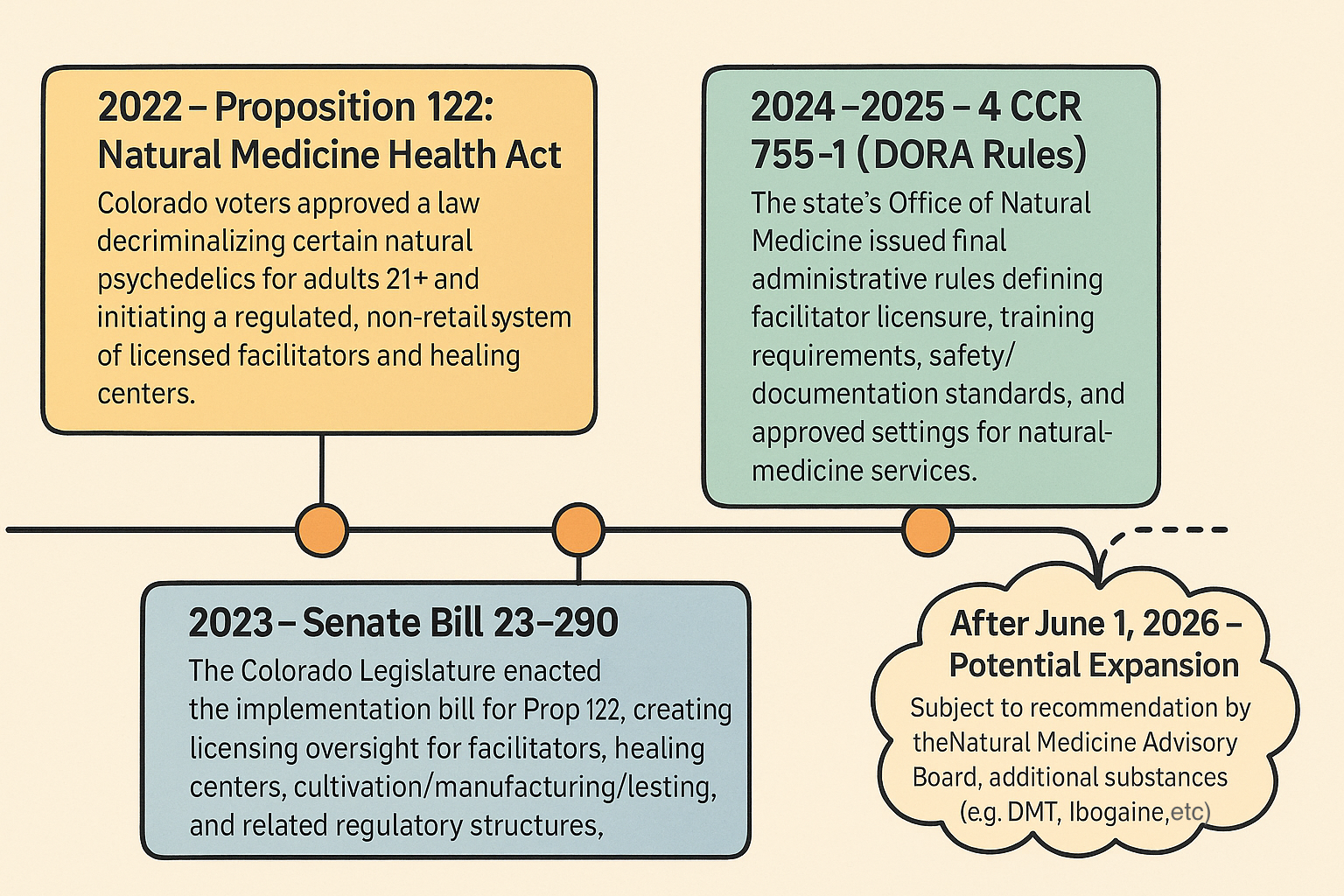
Colorado’s Natural Medicine: Key Laws & Milestones
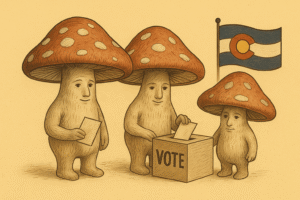 2022 – Proposition 122: Natural Medicine Health Act (NMHA) – Voter Initiative
Colorado voters approved the NMHA, decriminalizing adult personal possession, cultivation, and sharing, and directing the state to develop a regulated, non-retail facilitation system with licensed facilitators and healing centers.
2023 – Senate Bill 23-290 – Implementation Bill
Implements the NMHA: establishes licensing and oversight for facilitators, training programs, healing centers, and cultivation/product-preparation facilities, and defines permitted and prohibited conduct.
2024–2025 – 4 CCR 755-1 – Administrative Rules
The Department of Regulatory Agencies (DORA), via the Office of Natural Medicine, issued final rules detailing licensing requirements, safety/documentation standards, and approved settings for facilitation.
After June 1, 2026 – Potential Expansion (subject to recommendation)
If recommended by the Natural Medicine Advisory Board, the Department may add DMT, ibogaine, and mescaline (excluding Lophophora williamsii (peyote)) to “Natural Medicine.” Rules may be adopted prior.
A Regulated Approach to Psychedelic Healing
Unlike earlier decriminalization efforts, the Natural Medicine Health Act (2022) creates a new, state-regulated legal category for certain naturally occurring psychedelics. It decriminalizes personal use for adults 21+ and establishes the foundation for licensed healing centers and trained facilitators. This regulated approach opens the door to supervised therapeutic use of psilocybin (psilocybin-assisted therapy), supported by clear standards for safety, professionalism, and accountability. The broader program emphasizes education, informed consent, cultural respect, and community-centered values.
By recognizing the potential therapeutic and transformative benefits of natural medicines, including psilocybin, and with future review of DMT, ibogaine, and mescaline (non-peyote), Colorado is setting a national precedent. The Natural Medicine program offers a modern, ethical framework for guided psychedelic services, prioritizing safety, accessibility, and respect for the origins and cultural significance of these substances.
Healing Centers in Colorado : The Setting
Under Colorado’s Natural Medicine Health Act (NMHA), licensed healing centers and micro-healing centers, are the primary locations where facilitation work takes place.
These centers are designed to provide the Setting – encompassing the physical surroundings, relational atmosphere, and energetic quality of the space – all intentionally cultivated to foster safety, trust, and depth of experience during a journey (or administration session) with natural medicines such as psilocybin.
What Is a Micro-Healing Center?
- An intimate, community-based version of a licensed healing center
- License limits on-site storage of regulated natural medicine to no more than 750 mg of total psilocin
- Can be integrated into existing wellness or therapeutic practices (e.g., a clinician’s office or wellness center) rather than a full-scale dedicated facility
- All standard licensing, safety, facilitator, and integration requirements still apply – offering a more accessible, locally grounded model of care within the same regulatory framework
Who Guides Psychedelic Therapy in Colorado?
Facilitators are the trained professionals who guide participants through natural medicine experiences within Colorado’s regulated framework. They provide preparation, in-session support, and integration afterward, ensuring participants are supported at every stage of their journey.
Applicants for a Facilitator or Clinical Facilitator license must complete a state-approved training program, supervised practicum, and licensing through the Department of Regulatory Agencies’ Natural Medicine Division. Both roles emphasize ethics, informed consent, and participant wellbeing.
Two Types of Guides
Understanding Clinical and Non-Clinical Facilitators
Clinical Facilitators
- Must hold an active Colorado healthcare license (for example, physician, psychologist, therapist, nurse, or other behavioral-health professional).
- Completes the same facilitator training, practicum, and consultation requirements but may also support participants with existing medical or mental-health conditions, as long as it aligns with their professional scope.
- Can combine therapeutic or clinical expertise with facilitation, offering a more integrated, treatment-informed approach for those seeking deeper emotional or psychological work.
- Can collaborate with or refer to other healthcare providers to ensure coordinated, safe care when needed.
- Must maintain both their professional healthcare license and their clinical facilitator license to continue practicing within the regulated framework.
Facilitators (Non-Clinical)
- May guide participants independently when screening does not show medical (including certain prescription medications) or mental-health risks that require a healthcare provider’s involvement.
- Must complete a state-approved facilitator training program, including supervised practicum and consultation hours, before applying for licensure through DORA’s Natural Medicine Division.
- Cannot diagnose or treat medical or psychological conditions, or independently practice medicine or psychotherapy as part of facilitation work.
- Because facilitators do not provide therapy or clinical care, this role may be more limited for participants seeking deeper therapeutic processing, trauma-focused work, or integration connected to mental-health treatment.
Clinical Facilitator Roles and Medical Collaboration in Colorado’s Natural Medicine Program
Colorado’s Natural Medicine framework is not a prescription-based model. Natural medicines are not prescribed or dispensed through traditional medical channels. Instead, they are administered during structured facilitation settings, known as administration sessions (often called journeys), which take place at licensed healing centers.
Clinical Facilitators are licensed professionals who have completed the required Natural Medicine training and state licensure. Depending on their professional background, Clinical Facilitators may come from fields such as medicine, psychology, nursing, psychotherapy, or other licensed health disciplines. Within the Natural Medicine framework, Clinical Facilitators may provide preparation, facilitation during administration sessions, and integration support.
This work includes meeting with participants before and after the journey to support readiness, clarify intentions, attend to safety considerations, and assist with reflection and integration over time.
Each Clinical Facilitator brings their own professional training and scope of practice to the facilitation role. Medical, psychological, or therapeutic expertise may inform safety screening, medication awareness, trauma-informed support, and collaboration with a participant’s existing care providers when appropriate.
This collaborative model supports continuity of care while maintaining clear distinctions between medical treatment, psychotherapy, and Natural Medicine facilitation, ensuring that each aspect of support is offered ethically and within appropriate professional boundaries.
Access, Personal Use, and the Limits of Commercialization
Colorado’s framework centers on guided access, not commercial sales. Unlike cannabis, there are no retail dispensaries for psilocybin or other natural medicines. Substances are cultivated and prepared by licensed facilities and used exclusively during journeys (or administration sessions) at healing centers.
Colorado law also allows adults 21+ to possess, grow, and share natural medicines (e.g., psilocybin mushrooms) for personal use. They may not be sold, and facilitation with others may occur only under a licensed facilitator.
In short, Colorado aims for access without commercialization, keeping experiences within a regulated, service-based system that prioritizes safety, education, and community wellbeing.
The Path Ahead
As Colorado’s regulatory framework continues to evolve, it offers a living example of how modern medicine, traditional wisdom, and public policy can come together to support meaningful and responsible approaches to healing.
As Colorado’s model continues to take shape, it may serve as a thoughtful blueprint for other states exploring similar paths forward.
Interested in Learning More?
If you’re curious about psilocybin-assisted work or professionally guided natural medicine journeys, you’re welcome to reach out to learn more.
At Emergence Psychedelic Therapy, LLC, we’re glad to share general information, answer questions about how the process is structured, and help you understand what to expect as you explore whether this work may align with your intentions and goals.
You’re welcome to contact us anytime to continue the conversation or explore next steps.
The information in this blog is for educational purposes only and is not medical advice. Reading these articles does not establish a patient–provider relationship, and individual clinical recommendations can only be made within the context of a formal evaluation. It’s recommended that readers consult with their own medical and mental health providers before making any changes to their treatments, medications, medical and/or therapeutic approaches to their health care. Laws and regulations regarding psychedelic and natural medicines, vary by country, state, and local jurisdiction, and readers are responsible for understanding the policies that apply in their own area.